The Invisible Line
What we carry, what holds us back, and what it means to move forward.

“Do you ever feel weird?” Leah asks Simon in Love, Simon.
“Sometimes I feel like I’m always on the outside," she says. "There’s this invisible line that I have to cross to really be a part of everything, and I just can’t ever cross it.”
“Me too,” Simon responds.
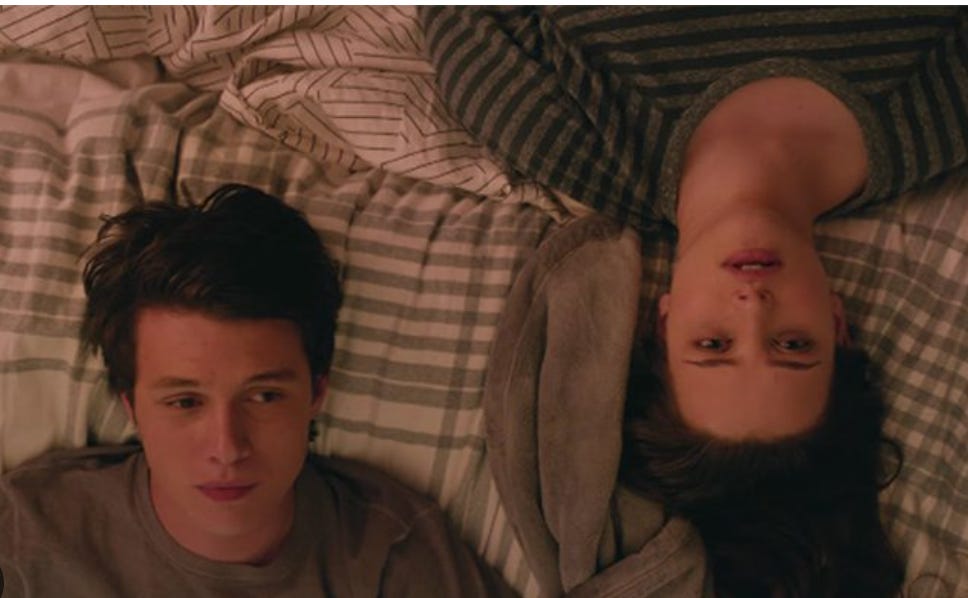
I think about that quote almost every day. Loneliness feels like a constant shadow pressing on me. People tell me I should feel accomplished: “You’re in medical school. You’ve had amazing opportunities. You’re so lucky!” And sure, from the outside, it might seem like I’m thriving. But no one talks about how loneliness can teach you to wear a mask. It becomes second nature—a survival mechanism so automatic you almost forget you’re wearing it.
Dr. Annesa Flentje, a researcher at UCSF, studies how stress impacts our genes, especially the kind of stress LGBTQ+ individuals experience. She calls it "minority stress," those “little punches” of discrimination or exclusion that pile up over time. They shape our automatic ways of thinking—patterns that can stay with us, unchallenged, for decades. “Whether we recognize it or not,” she says, “our bodies bring the closet with us into adulthood.”
And it’s true. When you grow up concealing who you are, adapting to avoid judgment, you don’t just leave that behind. You carry it everywhere. For me, that’s looked like a lifetime of pretending to be okay.
In medical school, the cliques are impossible to miss. I’m cordial with many, friendly with a few, but never truly in. It’s been like this my whole life. I’ll have one-on-one moments with people or engage in surface-level interactions where we act like there’s something deeper. On the rare occasion I’m invited to something, I look around at the couples, the friend groups, the easy laughter—and all I can think about is that invisible line. The one I’ll never be able to cross.
John, a former consultant who left his corporate life to make pottery and lead adventure tours, said something to a UCSF researcher that struck me: “We don’t have the tools to process stress as kids, and we don’t recognize it as trauma as adults. Our gut reaction is to deal with things now the way we did as children.” For me, that gut reaction has been pretending. Pretending I don’t care. Pretending I’m too busy to need a social life, love, or connection.
But then I see others having all of those things—effortlessly, it seems—and it stings. I hate how vulnerable I am. When people ask how I’m doing, I don’t sugarcoat it: “Terrible, scared, anxious, struggling.” It’s almost like I want to rip the mask off entirely, but instead, I end up broadcasting my pain to anyone willing to listen.
And yet, mediocrity feels just as unbearable. When you’re Type A, falling short—even slightly—feels catastrophic. The only solution, it seems, is success. But even that feels fleeting and fragile. For me, success means helping patients, making an impact, fostering connection. Maybe, by saving lives, I’ll find a deeper sense of purpose.
But the truth is, the lack of purpose right now is crushing.
The other day, I barely survived a medical school final—despite studying harder than I ever have in my life. The fear that washed over me was overwhelming. My family’s future depends on me. I’ll be their support as they age, their lifeline when their jobs offer little in return. Failure isn’t an option.
And yet, there I was, staring at the fallout, feeling like I’d let everyone down.
I wonder sometimes if my loneliness has roots in my identity. There’s an epidemic of loneliness that so many LGBTQ+ individuals carry, a weight of invisibility and exclusion. We carry the closet with us—every little adaptation to protect ourselves, every subtle shame that keeps us quiet. People probably caught the hints between my Taylor Swift references and the Love, Simon quote, but I rarely talk about it. The fear of repercussions is too deeply ingrained.

And it’s impossible to ignore the larger systems that deepen that weight. Watching the Trump administration strip LGBTQ+ rights, wipe out resources for HIV treatment, abortion access, and more—it’s devastating. I’ve fought to hold myself together, but I hurt for those who can’t, for the 1% of transgender individuals now fighting even harder just to exist. Aren’t we focusing on the wrong 1%?
I don’t have a clean resolution for this story. Maybe that’s the point. The invisible line is still there, and most days, I’m still staring at it from the other side. But maybe one day, I’ll cross it. Or maybe I’ll realize that the line was never real to begin with.
Love, Sami.
I know nothing whatsoever about growing up LGBTQ+ but I feel like this line is universal, "We don’t have the tools to process stress as kids, and we don’t recognize it as trauma as adults."
I wrote a whole book about the neglect and loss of my child hood that I didn’t even realize was probably my subconscious trying to process a deep seeded pain I am still struggling with into my forties.
I can't tell you it gets better but I feel like the only way things will ever get better is to keep trying. Good luck, brother.