Parallel Lives
by Sami Raihane

Hey friends…it’s been a little over a month, but I’m back, carrying a few things I didn’t know how to write about until now.
I often think about the parallel lives we live, the ones unfolding just beside our own. The paths not taken. The conversations never had. The versions of ourselves that might have existed if a single variable had shifted slightly out of place. I am, by nature, an overthinker, someone who rehearses nearly every possible outcome before life has a chance to surprise me. And yet, despite all that anticipation, there are moments that arrive unannounced. Stories that disarm me. Truths that land with a weight I did not realize I had been carrying.
Recently, I listened to someone describe what it meant to be queer in the early 2000s. Not in theory, not as a political timeline, but as a lived reality. They spoke about being threatened in school hallways, about how being visibly queer could make you a target before you even understood why. This was before the language of “online harassment,” before cruelty could be muted or reported or archived behind a screen. Bullying was physical, immediate, and often unescapable. I found myself instinctively minimizing my own pain, flattening my experiences by comparison. My adolescence took place in a world that felt, at least superficially, more tolerant. But progress is uneven, and history does not move forward in a straight line. It bends. It pauses. It leaves people behind.
My thoughts drifted backward, to the Lavender Scare of the 1950s and 1960s, when queerness was framed as a moral failing and a national threat, when lives were quietly dismantled through suspicion alone. Then forward again, to the passage of the Love Act in 2019, when the U.S. government formally apologized to LGBTQ+ diplomats whose careers had been erased by discrimination. An apology, however late, is still an acknowledgment. It says that the harm was real. That it happened. That it mattered.
To be queer often means learning how to live as an outsider early. Especially if you grow up in a place that cannot fully accept you as you are. On the surface, queerness is often treated as an accessory, the funny friend, the charming one, the so-called gay best friend who learns how to soften his pain into something palatable. Inside, though, there is often a quiet fracture. A fatigue that comes from absorbing rejection while performing resilience. From family members who frame their discomfort as morality, as though love itself were conditional. But that story belongs elsewhere.
I return often to high school. There was a girl named Grace Turner who attended Olympia High with me. I remember the way her golden hair moved through the crowded hallways, the near-misses of our schedules that never quite aligned. She had B lunch. I had A. She had fourth-period biology. I had third. Our connection lived in the margins. Notes passed across black science lab tables, the kind you could clean by lighting alcohol on fire. I would write something careful. She would respond later. The next day, I would rush to see what she had left behind.
We messaged on Twitter for months. I made her a One Direction mixtape. We traded Fifth Harmony lyrics and Taylor Swift songs like confessions. I believed I was in love, or at least as close as I knew how to be. What I did not know was that my messages were being shared, ridiculed, turned into a private joke at my expense. I had become a spectacle without my consent. The queer kid everyone understood except me.
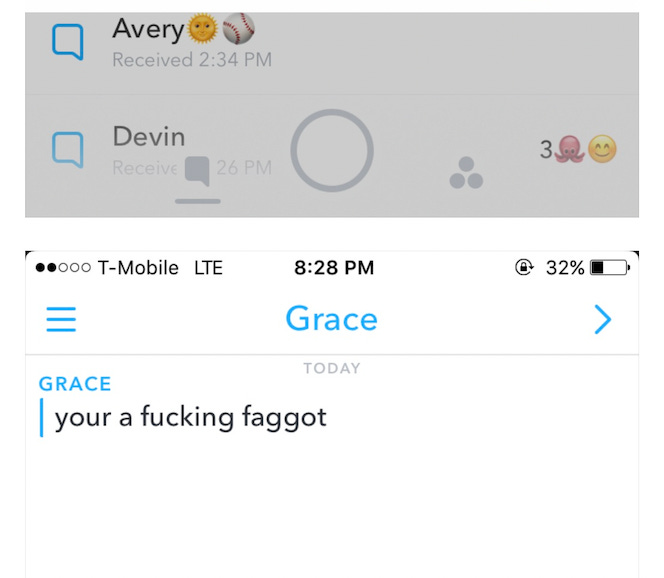
I remember sending her a Snapchat and seeing the gray arrow appear, the quiet confirmation that I had been removed. Moments later, a message arrived, not from her, but from her boyfriend, Alesso (they’re still together lol).
“your a fucking faggot.”
Even now, I notice the grammatical error. It is a small detail, but it has stayed with me longer than I wish it had. At least he didn’t miss the second “g.”
I have heard many stories like mine, some gentler, many far worse. I knew I was different long before I had language for it. I picture my kindergarten self holding a rainbow-and-flower plate I made in art class, my mother hugging me tightly, unaware of how much that tenderness would one day be tested.
When I think about that child and who I am now, something in my chest tightens. I accept my queerness most days, but there are fractures, moments when fear seeps in uninvited. Internalized homophobia is not something you outgrow. It is something you unlearn slowly, unevenly, often painfully. There is a quiet inadequacy that shadows many queer men. Add to that a personality driven by achievement, by the need to excel academically while still cultivating a rich and meaningful life, and exhaustion becomes inevitable.
No matter how deliberately you move toward authenticity, there are parts of you that feel impossible to conceal. The softness in your expression when you laugh. The tension under your eyes when anxiety settles in. I once read an essay that described homosexuality as unmistakable. That word has never left me. Some men cope by seeking endless validation. Some disappear into silence. Some do not survive at all. Validation becomes a currency you pursue, even when you know it will never fully satisfy.
Then there is the loneliness. The persistent sense of standing just outside the room. Many queer men carry some version of high school trauma, or no romantic history at all until much later in life, often after leaving home for a larger city. For some of us, queerness was unsafe where we grew up. For others, the dating pool was so small it felt imaginary. Straight peers, while not spared from heartbreak, often experience it earlier, without the added burden of having to explain or defend who they are.
This is not to dismiss the pressures straight men face. Fragile masculinity causes real harm as well. But the comparison reveals how deeply embedded these wounds are across identities. I notice it in the looks from friends, the curiosity, the quiet astonishment when they ask what my life is like.
I am still searching for validation. Every day. And when I come close to connection, something often intervenes, narrowing the possibility of what might grow. Some of that I keep private. What I can say is this. There have been nights spent staring at the ceiling, days lost to inertia, moments when getting out of bed felt heavier than any exam. And yet, somehow, I moved forward. Through undergrad. Through medical school. Assembling resilience from fragments.
The anxiety queer people carry is generational. It is inherited, even when the world insists it has changed. But so is the perseverance. The quiet insistence on belonging. I am still working on myself. I always will be. And I carry the stories of those around me, their pain and their survival, with me.
No matter when we are born, or where, or how carefully we learn to protect ourselves, the truth is embarrassingly simple. We are all reaching for the same things. Love that does not require translation. Recognition that does not come with conditions. A sense that our lives take up legitimate space in the world. The tragedy is not that this desire is unique to queer people. It is that so many of us have had to fight so hard just to feel human.
Love, Sami
This is heartbreaking and beautiful
Couldn't agree more. You really nailed the "progress is uneven" bit. So much to unpack there.